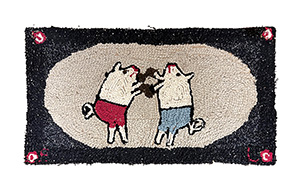
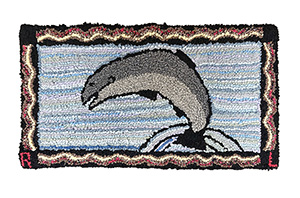
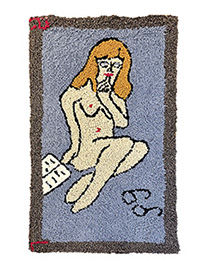
Ernest Raymond Scott (1905 - 1991) and Lydia E. Clarke Scott (1908 - 1996)
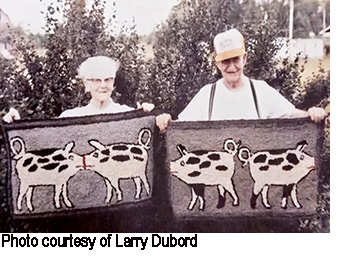 Ernest Raymond Scott and Lydia E. Clarke Scott were celebrated hookers from Gagetown, New Brunswick, whose partnership became one of the most distinctive collaborations in Atlantic Canadian folk art. Married in 1931, they settled on Lydia's family farm in Summer Hill, raising pigs and dairy cattle until 1952, when the Government of Canada expropriated their land to build Canadian Forces Base Gagetown. The loss of their home and livelihood struck hard, especially for Raymond. In the year that followed, as he struggled to adjust, Lydia encouraged him to take up hooking as a way to steady himself. He did, and he never stopped.
Their working method was as personal as it was practical. Raymond had learned to hook from his mother, Effie Rae Nickerson Scott, who hooked out of necessity and traded her mats for new flooring. Lydia, artistic and sure handed with design, began drawing patterns and choosing colours for Raymond, who was colour blind but exceptionally fast. Together they created a seamless partnership in which each mat depended entirely on both of them. Lydia supplied the imagery and palette, often drawn from their farm life, while Raymond brought those scenes to life with his daily, almost meditative hooking practice. By the early 1980s, their work caught the attention of Maine dealers Larry and Jean Dubord, who were astonished by the charm of the rugs filling the Scotts' home.
The Gagetown Hookers became known for their joyful simplicity, and the unmistakable character of their shared hand. Their mats travelled widely, most leaving New Brunswick for collectors in the United States. Eventually both Lydia's and Raymond's names appeared on their work, acknowledging the essential dual authorship that defined their practice. Their legacy continues to influence rug hookers across the region.