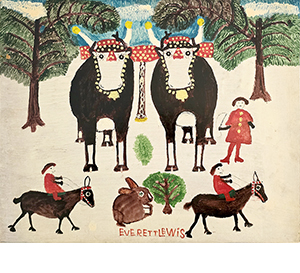
(1893-1979)
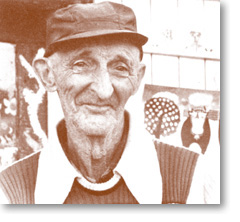 Raised in rural Nova Scotia, Everett Lewis spent his early years working as a farm labourer and fish peddler. In 1938, his life changed dramatically when he married Maud Dowley. Seeking stable employment, Everett became a night watchman at the Marshalltown Poor Farm in their community.
Throughout their marriage, Everett provided unwavering support for Maud, whose struggle with rheumatoid arthritis limited her ability to carry out household chores. Everett assumed responsibility for the home, allowing Maud to focus on her painting, a pursuit that would eventually bring the couple financial stability. He recognized Maud's talent early on and purchased her first set of oil paints, nurturing her creative spirit and encouraging her to share her work with others.
As Maud's unique paintings began to gain attention and her popularity soared, the demand for her art became relentless. Everett responded by helping her overcome physical limitations; he devised cardboard templates, encouraging Maud to sketch oxen that he would cut out so she could use them repeatedly in her artwork. These practical innovations enabled Maud to keep producing her beloved scenes, even as her hands became more afflicted over the years.
After retiring from night watch duties, Everett himself began to explore painting, using his own horse templates and capturing maritime scenes, landscapes, and animal subjects inspired by their surroundings. His contributions, though less famous than Maud's, reflected their shared appreciation for Nova Scotia's rural life.
Tragically, Everett's life was cut short in 1979 when he was killed during a robbery at their Marshalltown home. His steadfast devotion, inventive spirit, and partnership with Maud remain an integral part of her legacy, honoured by all who love her art and story.
Ref: Marie Ellwood, Folk Art of Nova Scotia (1976); Kobayashi/Bird - A Compendium of Canadian Folk Artists (1985); Blake McKendry, An Illustrated Companion to Canadian Folk Art (1999); Ray Cronin, Nova Scotia Folk Art: An Illustrated Guide (2024).